


Contract Lifecycle Management (CLM) is the process of tracking and managing every aspect of a contract for its performance, compliance, and other success factors through every stage of the document's lifecycle — from execution to renewal or expiration. The management process itself begins when a contract is proposed or requested and continues throughout the delivery of the promised good or service and into contract renewal.
Contract management in an organisation is too often the responsibility of someone who does not have the responsibility for entering into agreements. In practice, contract management is often assigned to a department that lacks the authority to negotiate or enforce a contract.
In practice, contract management is often assigned to a department that lacks the authority to negotiate or enforce a contract. In fact, the nature of contract management is such that it makes sense only when done in cooperation with managers responsible for entering into agreements and with those responsible for monitoring compliance.
When you're managing a contract, tracking every change, communicating key dates and deadlines, and maintaining compliance and performance are essential to its success. This can be challenging for any company that relies on multiple systems and data entry to track contract details and milestones.
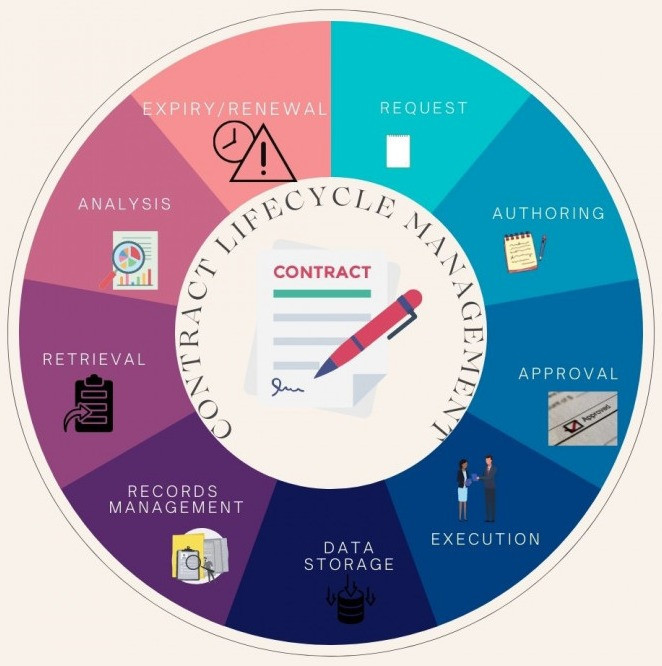
Stages of Contract Lifecycle Management(CLM)
The contract lifecycle is a journey full of different stages and players, each with their own requirements. This makes tracking, managing and executing contracts a challenging task. Contract management software (CMS) can help companies manage their contract lifecycles, from drafting contracts and making sure they are approved through to automated contract clauses and effective payment processes. CMS solutions allow users to manage every part of the contract lifecycle, improving efficiency for your organization.
Contract Lifecycle Management (CLM) is the process of managing a contract throughout its lifespan, including all aspects of contract management, such as; request, authoring, negotiation, performance, reporting, and re-negotiation. As contracts are negotiated and approved they are transitioned between stages in the contract lifecycle. The following are the most common stages found within the Contract Lifecycle Management process:
Contract Request: In the Request stage, a request for proposal (RFP) is created that outlines the specifics of the desired contract and is distributed to potential vendors who will respond with a proposal.
Contract Authoring: During the Authoring stage, a legal team creates a contract based on the information outlined during the Request stage using either a template or an example. After creating and reviewing the contract, it is sent to both parties to be signed and approved.
Contract Negotiation: During contract negotiation both parties communicate back and forth regarding specific details of the contracted agreement and complete negotiations as to how they will fulfil their obligations outlined in the contract.
Contract Approval: After both parties have communicated and successfully completed contract negotiations, they will sign off on the finalized document which will then be sent to their team members responsible for tracking contract performance.
Contract Lifecycle Management (CLM) is a necessary process for many businesses. It's a task that must be tackled frequently and requires the constant involvement of different departments, whether it be legal, accounting, or compliance.
Finalisation, Negotiation, and Re-negotiation
For many organisations, contracting begins with a request for proposal (RFP). This is the first stage of the CLM process in which procurement teams gather information from prospective or existing vendors to secure a new contract. Procurement then continues the CLM process by drafting and reviewing the RFP, which is sent out to prospective vendors.
After sending out the RFP, the procurement team may wait a few days or weeks before receiving responses back. Each response will then need to be reviewed by legal. Once legal reviews all responses and determines the winning bid, purchasing must negotiate everything from payment terms to product specifications and delivery schedules with the winning vendor.
Once all items are agreed upon, purchasing moves forward to negotiating terms in greater detail before signing a contract with the vendor. Lastly, purchasing will begin monitoring performance metrics to ensure quality and compliance with contract terms. At any point throughout this process, should performance metrics not meet expectations, purchasing can renegotiate contract terms with vendors at any time.
Conclusion
Contract Lifecycle Management is a vital aspect of project management. In order to ensure the best results for any contract, it's important that there is a system in place that has room for managing and tracking the life of a contract from beginning to end. Contract lifecycle management provides a very practical method for making sure that all steps are being successfully completed. In addition, it establishes a standardised process that can be integrated into other processes, like project management.


