


How To Easily Grind Coffee Beans Without Grinder-6 Ways -

Table of Contents
In every country around the globe, people begin their days with a cup of coffee. The quickest and most convenient way to prepare the best coffee is to grind coffee beans daily, and the best coffee grinder for this task is one that is designed for this purpose.
But suppose you don’t own a grinder? How can you prepare that crucial cup of the daily coffee morning using freshly ground coffee?
You don’t need to hurry out and purchase a grinder before breakfast to get the same flavor and quality; all you need are a few basic kitchen utensils and a little elbow grease.
Purpose Of Grinding Coffee Beans:
Although it is not necessary to ground your beans before brewing, doing so will significantly reduce the brewing time. The pot of coffee would have to be brewed on the stove. To enable the maximum amount of each bean to be exposed to the water, grinding is required.
The grinding of the beans not only exposes more of the oils to the water during the brewing process, but it also exposes more of the oils to the air, which causes the oils to evaporate faster. Therefore, it is recommended to -just grind the amount of beans necessary for the desired number of cups at a time. When taking into consideration the amount of time and effort required to grind coffee beans, it may be tempting to grind enough beans to make enough coffee for several days. However, doing so will lead to a decrease in the coffee’s overall quality.
TOOLS TO GRIND COFFEE BEANS WITHOUT A GRINDER
Managing with limited resources requires creativity. Check to see if you could get any of the following items in your kitchen, lodging, or camp:
- Blender
- Pestle and mortar
- Hammer (or mallet/meat tenderizer)
- Rolling pin
- Knife and chopping board
- either huge pieces of parchment paper or plastic Ziploc bags
- paper towels to avoid dispersion
- Elbow Grease
How to Grind Coffee Beans Without Grinder -6 Easy Methods
1-Using a Blender:
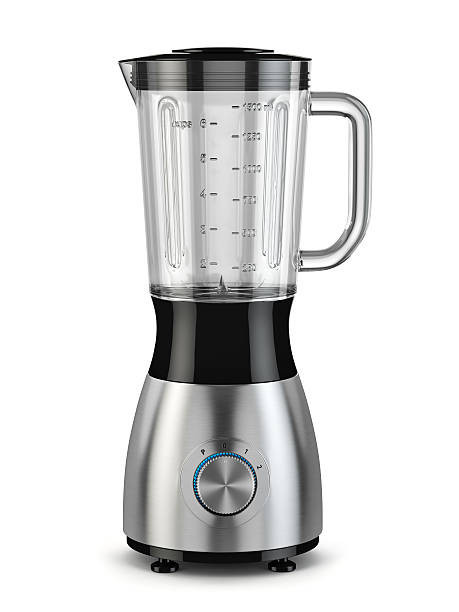
- since Blender is a common gadget, almost everyone has a blender, which is essential for making shakes and smoothies. Everything from creating delightful frozen drinks to mixing your preferred nut butter can be achieved with it. So you can replace a blender with your coffee grinder in the case when the grinder is not available. A blender will operate as a blade coffee grinder. Coffee is chopped by the blender’s blade in a way that resembles a blade grinder. As a burr grinder, it will not be as efficient. But still, that’s a viable trick.
In fact, some blenders have a “grinder” option especially for grinding coffee beans. It’s important to remember to just pulse the blender for short periods of time rather than letting it run constantly while grinding materials. Because the blades run at fast speeds and can overheat the Coffee beans, there is a possibility that the natural oils in the coffee beans will be overheated. If this happens, the resulting cup of coffee would have a harsh and bitter flavor.
Following are the steps to follow in order to grind coffee beans in your blender, regardless of whether or not it has the grinder settings:
- If your blender has a preset labeled "grinder," you should use that. If not, choose a speed between medium and high.
- A little quantity of coffee should be poured into the blender, and then the cover should be securely fastened on top.
- The beans should be ground using the pulse setting for short bursts ranging from three to five seconds. If you wait much longer, you run the danger of overheating the beans, which will produce a coffee that is harsh and unpleasant in taste.
- To achieve the best possible results, tilt the blender ever-so-slightly from side to side as the beans are being ground. This encourages the bigger pieces of the beans to migrate into the path of the blades, which ultimately resulted in a more uniform grind.
- Repeat the process of emptying the blender, adding more beans, and blending again until you have ground the necessary quantity of coffee.
2-Using Mortar and Pestle:
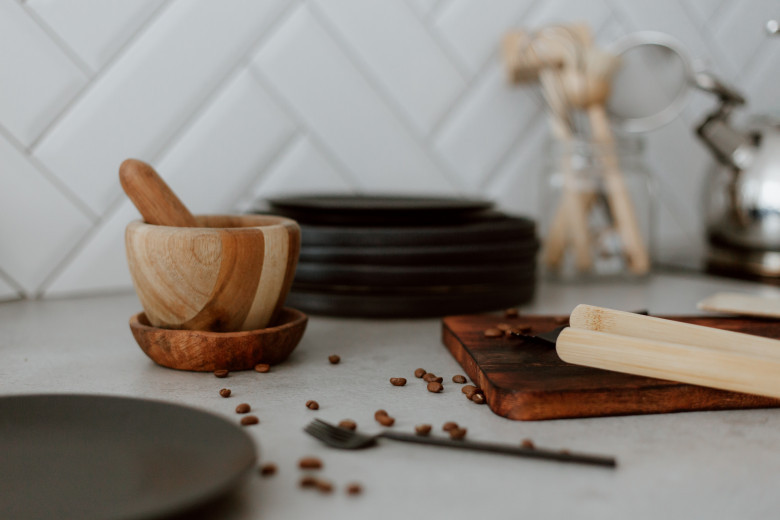
The mortar and pestle is perhaps the method that requires the biggest amount of time investment, yet it has been used for millennia all over the world to crush spices, sauces, salsas, and even meats. Because of this, it is the most suitable option for grinding your coffee beans.
With this technique, you can precisely manage a wide range of grinds, from those that are coarse enough for a French press to those that are delicate enough for Turkish coffee.
While any mortar and pestle can do the job, using one that is less porous, such as one made of ceramic, will reduce the formation of a flavor that is similar to bitter coffee.
Another type of mortar and pestles would still work, but those made of particular stones and types of wood can absorb coffee oils and give a bitter taste to everything else you grind with them.
How to use:
- Put a couple of scoops of coffee beans into your mortar and mix it up. For optimal control, fill it no more than one-fourth of the way up at most. You always have the option of grinding a new batch.
- Your dominant hand should be the one to hold the pestle, while the other should be used to keep the mortar steady.
- Use the pestle to apply forceful downward pressure and smash the coffee beans while turning the pestle in a circular motion.
- After it has been pulverized, roll the coffee about in the bowl with the pestle until it has the correct consistency and texture for your tastes.
- In this case, you need to grind additional coffee, transfer the coffee that you have previously ground into a bowl (or your coffee maker), and continue the procedure until you have the desired amount of coffee.
3-Using Hammer:
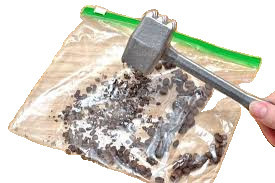
You may even substitute your hammer for your coffee grinder in an emergency. This technique involves using a meat tenderizer to crush your beans into a consistency that can be consumed.
A ziplock bag, a flat, hard surface, such as a counter or chopping board, and a meat tenderizing hammer are required.
- Put the required amount of beans in a freezer or Ziploc bag. Air should be squeezed out just before closing. Next, put the bag on a cutting surface that is hard enough.
- The beans should be thoroughly crushed by pressing your hammer with force until you achieve the right thickness. The bag shouldn't be hammered as if it were a nail. To prevent ripping, you might cover the bag with a cloth.
- To achieve a precise grind, constantly shift the smashed beans to one side of the ziplock bag. A consistent coarse to medium-coarse grind will be made possible by doing this.
4-Using Rolling Pins:
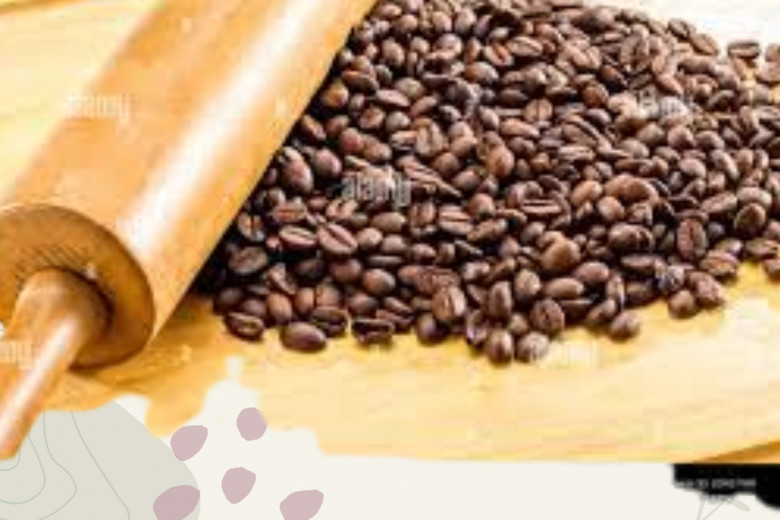
When we bake things like bread, cakes, and pastries, we typically use a rolling pin. However, coffee beans can be crushed with a rolling pin instead. Because of the way it is designed, it is capable of producing a grind that is quite consistent. The usage of a rolling pin is quite similar to the use of a hammer. On the other hand, grinding coffee beans demands a physical effort.
In this technique, a zip lock bag is required as well.
In order to grind coffee beans with a rolling pin, follow these steps:
- Put the required quantity of coffee beans that you want to grind into a Ziploc bag.
- After the bag has been sealed, Put the bag on the cutting board or the hard surface available. Move the beans around until they form a single layer by shaking them.
- While using a rolling pin to crush beans, rather than hitting it, you just roll the pin back and forth over the beans to crush them.
- Keep rolling the pin back and forth over the beans until you're satisfied with the consistency.
This technique is believed to be one of the least recommended methods; you should only use it if you have no other choice.
5-Using a Knife:
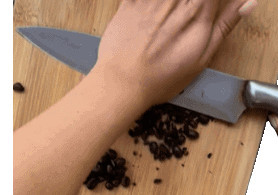
This technique is believed to be one of the least recommended methods; you should only use it if you have no other choice.
You always have the option of using a knife to do the job if none of the other options are available to you. Since you want to crush the beans into a powder, a knife with a strong and sturdy blade will be required.
Crushing beans using the flat side of the blade allows you good control and enables you to achieve a grind that is medium to medium-fine in consistency.
- Put the beans in the center of the cutting board.
- Put the blade of the knife down on the coffee beans in a flat position.
- To break the beans, place the palm of your hand with the flat side down on top of the blade and push down forcefully.
- Do not give in to the temptation of striking the blade. doing so will cause the beans to bounce and fly away, resulting in the possibility of losing some of them.
- Once the beans have been cracked, begin to carefully slide the knife in your direction of you. Maintaining the pressure will result in the beans being ground to an even finer consistency.
Although it is possible to grind your coffee beans, however, this technique is not suggested since it presents the risk of injury. Not to ignore the fact that it would take an unimaginably long time.
6-Using a Food Processor:
Although it is possible to grind your coffee beans, however, this technique is not suggested since it presents the risk of injury. Not to ignore the fact that it would take an unimaginably long time.
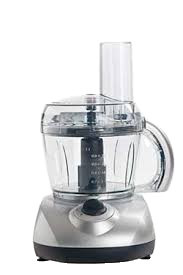
Do you have a food processor in your home? If this is the case, you now have the option of a new technique for grinding coffee.
So, If you have a food processor rather than a blender, you can ground coffee beans in it exactly as you would in a blender.
The results will be comparable to those of the blender, but you’ll need more beans because a food processor’s diameter is often larger than a blender’s.
If you’re just 2 people, double the amount of coffee would work, and you’ll have grounds left over for the next. Just be sure to keep the unused grinds in a plastic bag that is airtight.
How to do:
- Add the required quantity of Coffee beans (1/2 to 1 cup of beans) into the food processor's container.
- Ensure that the lid is securely placed on the top.
- Using your processor's "pulse" function, grind for a maximum of 3 to 5 seconds, When grinding beans, twist the processor just enough to allow the bigger pieces to fall into the blades, to achieve consistent results.
How to Choose Grind For Different Brewing Techniques?
Coarse grind:
The grind must be adjusted to the appropriate consistency based on the brewing technique. Coffee that has been ground very coarsely is roughly the size of breadcrumbs. Blenders and food processors both have the capability of producing a grind that is rather coarse. This grind is just right for the following Coffee makers:[1]
- French Press (press or plunger pot)
- Toddy Makers (cold brew method)
- Vacuum Coffee Maker
- Percolator (perish the thought!)
Medium grind:
A medium grind resembles granulated sugar in terms of texture. The pour-over technique, Chemex brewers, and drip coffee makers all benefit from using this kind of grind. Despite the fact that it may be used for a variety of brewing techniques, the medium grind is not recommended for espresso or Turkish coffee.[2]
- Coffee beans can be cracked with a knife or a hammer to obtain a medium grind, or they can be crushed with a rolling pin.
Fine Grind:
This powdery/mealy grind, often known as an espresso grind, is most suited for espresso machines and Neapolitan flip-drips, although it may also be utilized in electric drip and filter brewing.
If you want to use an espresso machine, a home coffee maker, or a stovetop brewer, the coffee should be ground very finely. This is because coffee that has been ground very finely is essential for these brewers to extract the most flavor out of the coffee. Coffee that has been ground very finely into a powder has a texture that is comparable to that of conventional table salt.
Super fine grind:
This special grind is necessary in order to make Turkish coffee and Greek coffee. If you are willing to put in a little more work, you may get this grind by using a pestle and mortar. Coffee that has been ground to a superfine consistency resembles powdered sugar in appearance.
To compare and contrast, what are the characteristics of ground vs whole bean coffee?
By purchasing whole beans and then grinding them at home, you may keep the taste of your coffee, as well as the beans themselves, more fresh for a longer period of time. The taste is unmistakably superior when compared to purchasing coffee that has already been ground, however, the process is more time-consuming.
Because Coffee beans are rich in oils, which provide taste and fragrance to the brewed beverage. A large proportion of those oils is found inside the bean’s own tissue. When you grind the beans, those oils are released, which enables the water to more easily absorb them throughout the brewing process. When the oils in the beans are exposed to air, they tend to evaporate, which happens after some time has passed.
Purchasing coffee beans that have already been ground makes brewing the coffee in the early morning considerably simpler, but the coffee becomes stale much more quickly. Even when vacuum-sealed, the taste of coffee in cans will degrade more quickly than that of whole beans.
Conclusion:
Though a Good Quality Coffee grinder is important to get fine results and save time if you don’t own a grinder or you are on a journey, these simple grinding methods will work for you.
The best way to grind coffee more finely, we would suggest you use a mortar and pestle. A cup of coffee with a lot of taste comes from a uniform, coarse grind, which is easy to achieve using a mortar and pestle. Additionally, they are very simple to clean; however, you should choose a smooth one so that the coffee smell doesn’t spread to your other dishes.
But if you have an electric option i.e Blender or Food processor go with them. Don’t forget to tilt slightly while grinding in a blender or food processor, if you want a more coarse, even grind and excellent taste.
Also Check: Why does Coffee Taste Bitter


